Is print dead? It’s too soon to start writing the obituary

The news continues to come with gasps of amazement. Twenty years after its founding, SmartMoney magazine will dump its print edition in order to focus on SmartMoney.com! Twenty-five print staffers will lose their jobs! By the end of the year the Financial Times could have more digital subscribers than buyers of print copies! U.S. publishers report that foreign e-book sales last year increased 333 percent over 2010 sales! Is print dead? Or, at best on life support?

Probably not. A 2012 Reynolds Journalism Institute study confirms that tablet users continue to read print newspapers and magazines. Nearly half of Apple iPad owners and a quarter of Android table owners say they have a subscription to at least one print publication. A recent Pew State of the News Media study noted that a quarter of Millennials (18-24 year olds) said they read a printed newspaper the day before. Some 22 percent said they read newspapers at least every other day. That is compared with 40 percent of adults overall who say the same. The New York Times reports that 10 percent of its hard copy subscribers are Millenials; 9 percent subscribe digitally.

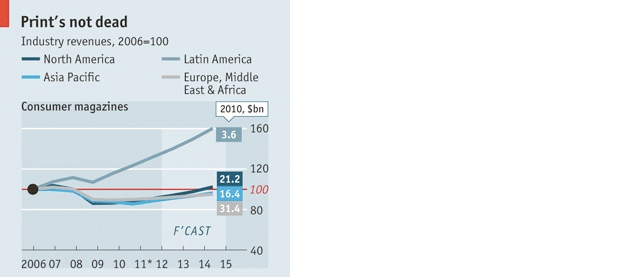
In the U.S., more print magazines were launched than closed in 2011, the same trend as evident in 2010. The Economist, a highly-respected British news magazine, writes about a new sense of optimism among publishers due to the increased readership of magazines. In fact, magazine audiences are growing faster than those for television or newspapers.

So, what accounts for the statistics of the first paragraph? The editor of SmartMoney magazine says the volatility of markets and asset classes has increased the need for rapid delivery of personal finance intelligence. Also, the magazine was losing ad pages. Thus the decision to cut their losses and try the digital model. Why is the Financial Times increasing digital subscribers at such a rapid rate? The magazine was one of the first to recognize the possibility of monetizing content on the Web and from the beginning charged for content that they made sure offered quality, rather than quantity. And, they were innovative in their approach to technology, opting for HTML5 very early on, with the result that their Web app drew 2 million users in less than a year.

What about the growth of foreign e-book sales? After all, a 333 percent increase is pretty amazing, isn’t it? Perhaps not so amazing when you realize that even after its phenomenal growth last year,  e-book sales still represents only 6 percent of total sales.

Perhaps some day print will die. But that day will not come this year, next year, or even next decade. Save the obituary writing job for your grandchild.
Four ways to evaluate your magazine’s purpose statement

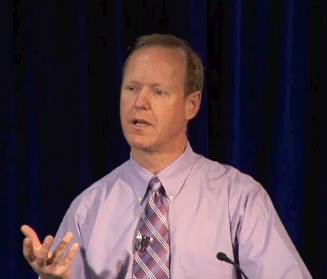
Kent Wilson teaches the session on Developing a Business Strategy for your magazine

You probably already have a purpose statement for your magazine, if not on paper at least in your head. But is it as good as it could be and is it accomplishing all you wish? Answer these questions to see whether your purpose statement accomplishes its goals.

1. Is it written down on paper and accessible to every staff member and every freelancer? Every person who works with your magazine in any way should know who the target audience is, what the publication is expected to do for them, and how you will do it. If this is not clear to everyone, your staff may become confused and disagree on direction, and your magazine will lose focus.

2. Is it succinct? A great purpose statement may be only one or two sentences, clearly stating who, what, and how, incorporating the audience, desired result, and method of accomplishing the result.

3. Does it guide your decisions on how and what you will publish?

4. Is it practical for decision making?

Learn more about writing an effective purpose statement in the video offered for free streaming on MTI’s Web site. The video on Strategic Planning for Magazines includes information on developing a business strategy, with help in  developing a purpose statement, a vision statement, and defining your values.

http://www.magazinetraining.com/FreeVideoAccess/

The State of Magazine Publishing Today—A definitive answer…more or less

What is the state of magazine publishing today? It appears to be a multiple choice question. And the answer is, “All of the above.”

An article in last week’s The Economist print edition stated that magazine publishing has been infused with a new sense of optimism. Magazines are still attractive to advertisers and there is strong reader loyalty, the author states. Moreover, magazines have learned to harness digital technology in innovative ways. And, for the second year in a row, more magazines were launched in 2011 than closed.

Meanwhile, the opposite point of view is argued in a blog post on the Economist Group’s Lean Back 2.0 blog, in which the author Rishad Tabaccowala states that “tablets will hasten the demise of magazines and not save them.” Tablets put magazine content on the same level as games and social media, he says. And the iPad disrupts magazine publishers’ tight control over distribution and damages their ability to bundle content together. In short, Tabaccowala describes the state of the magazine industry as a “headache.”

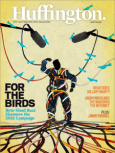
Then, there’s the Huffington Post, a well-known blog which this week launched an iPad magazine called “Huffington.” The weekly publication will offer longer pieces than on its blog, with photo essays and and data visualizations. Subscribers will pay by the issue, month, or year.

So, what is the state of magazine publishing? Disastrous or encouraging? Growing or heading for oblivion? Is the iPad the new frontier in magazine publishing or will it deal the final blow to the industry?  And the answer is….Yes.

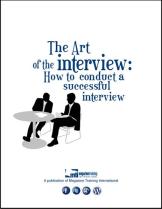
The art of the interview–10 guidelines for a successful interview

Unless all your magazine and newspaper articles are written in the first person, at some point you will need to interview someone. Can you guarantee that every interview you attempt will be be successful? Probably not. But, there are some guidelines you can follow that will make it far more likely your interview will yield exactly the information you need for a successful article.

1. Be prepared. Define your purpose; know exactly what you hope to gain from the interview. Research the person to be interviewed and the topic. If you don’t prepare well, how will you know what questions to ask in order to elicit the information you need?

2. Prepare your key questions in advance and write them down. You will want to explore new directions and interesting possibilities during the interview, but prepared questions ensure that you will not forget the important things you want to ask.

3. Make an appointment if possible and establish a time limit. Don’t just try to catch your interviewee in a free moment. You will have a better, more relaxed interview if your interviewee has set aside the time to talk with you.

4. Select the right interview location. Be aware that interviews in the interviewee’s office may be interrupted by the telephone and interviews of mothers in their homes may be interrupted by the demands of children. Try to find a private place where you won’t be interrupted.

5. Set the tone of the interview. Break the ice right at the beginning; set a friendly, non-threatening tone and explain what you want to accomplish with your interview.

6. Even if you must ask some tough, sensitive questions during the interview, start with the easy, non-threatening questions to get the interviewee comfortable with the interview and used to talking.

7. Ask the right questions. Don’t assume anything; even ask questions with an “obvious” answer. You may be surprised by a response you could never have predicted. Don’t ask “leading” questions that assume a certain answer and don’t ask a question every time the interviewee pauses for breath. Ask concrete questions to elicit details that will make your article more interesting.

8. Guide the interview. Don’t interrupt a helpful train of thought; write down questions to follow up. But, don’t let the interviewee take off on an unhelpful tangent.

9. Avoid debating with the interviewee. Your interviewee may express opinions with which you don’t agree. Avoid the temptation to turn the interview into either a conversation or a debate. You’re there to get the information you need, not to have a discussion. Set aside your own opinions until the end of the interview and then if you wish to get into it with the interviewee, feel free to wade in.

10. Ask for final thoughts. You may discover important information you hadn’t thought to ask about.

For more information on the Art of the Interview, you may download a free ebook from Magazine Training International.